
Dunia medis terkadang terasa seperti sirkus tanpa akrobat. Obat yang sudah lama malang melintang di ruang operasi transplantasi, yang bahkan nenek pun mungkin mengenalnya sebagai "obat sakti," ternyata punya peran baru sebagai penjaga gerbang di perbatasan tipe 1 diabetes. Riset terbaru membisikkan bahwa obat murah meriah ini bukan cuma buat ngerakit ulang organ orang, tapi juga bisa bikin penyakit autoimun yang menyerang sel penghasil insulin itu sedikit melambat langkahnya. Siapa sangka, sesuatu yang dianggap kuno bisa jadi solusi futuristik?
Dulu, dosis tinggi dari Polyclonal Antithymocyte Globulin (ATG), si penekan sistem imun yang tangguh, sudah terbukti mampu mengurangi gerogotan sel beta pankreas pada penderita diabetes tipe 1 yang baru terdiagnosis. Nah, riset terbaru ini membawa kabar yang lebih menggembirakan: dosis yang jauh lebih kecil ternyata hampir sama ampuhnya memperlambat progres penyakit, tapi dengan catatan sampingan yang lebih bersahabat. Bayangkan saja, seperti menemukan cara mengalahkan bos level akhir dengan jurus pamungkas yang tidak membuat karaktermu kehabisan HP.
Di dalam kubu diabetes tipe 1 (T1D), tentara sistem imun tubuh malah menyerang balik prajuritnya sendiri, yaitu sel beta. Sel-sel mungil ini adalah pabrik insulin, hormon krusial yang bertugas mengantar glukosa dari aliran darah masuk ke sel-sel tubuh untuk dijadikan bahan bakar. Tanpa cukup insulin, glukosa menumpuk di darah, menciptakan kekacauan layaknya kemacetan parah di jam pulang kerja.
Namun, ada masa emas pasca-diagnosis, yang oleh para ahli disebut "fase honeymoon." Di periode ini, sel beta masih berjuang memproduksi sedikit insulin. Momen inilah yang menjadi target intervensi, sebuah kesempatan emas untuk menjaga sisa-sisa sel beta agar bertahan lebih lama. Semakin panjang fase honeymoon dan semakin banyak fungsi sel beta yang tersisa, semakin rendah pula risiko komplikasi diabetes yang mengerikan di kemudian hari, seperti penyakit jantung dan ginjal. Ini seperti punya cadangan energi tambahan saat marathon maraton terpanjang.
Sebuah studi baru menyoroti fase kritis ini dengan melibatkan 117 partisipan berusia antara 5 hingga 25 tahun, yang baru saja didiagnosis T1D dalam kurun waktu sembilan minggu sebelum studi dimulai. Mereka dibagi ke dalam tiga kelompok yang menerima dosis ATG berbeda: dosis tinggi (2.5 mg/kg berat badan), dosis menengah (1.5 mg/kg), dan dosis rendah (0.5 mg/kg). Ini seperti memilih tingkat kesulitan dalam sebuah game untuk melihat efek maksimal.
Hasilnya, dosis terendah terbukti mampu menjaga fungsi sel beta tetap utuh selama setahun penuh. Penemuan yang dipublikasikan dalam jurnal bergengsi The Lancet ini mengindikasikan bahwa minimalisasi dosis bukan berarti minimalisasi manfaat, sebuah prinsip cerdas yang patut diacungi jempol.
Dr. Chantal Mathieu, seorang endokrinolog yang memimpin studi ini, menjelaskan bahwa tujuan utama adalah mencari dosis efektif terendah, terutama untuk anak-anak usia 5 tahun ke bawah. Mengapa? Karena efek samping obat, seperti reaksi imun yang merugikan, bisa menjadi beban berat bagi mereka yang tubuhnya masih dalam tahap perkembangan. Keseimbangan antara efektivitas dan keamanan memang selalu menjadi tantangan tersendiri, seperti mencoba menyeimbangkan piring penuh makanan di atas bola disko.
{"system_instruction":"You are a strict and witty editor. Output MUST be purely in HTML. The VERY FIRST line of your output MUST be a tag containing the introduction. DO NOT start with an or any title. ABSOLUTELY NO use of pronouns like 'Anda', 'kamu', 'kita', 'kami', 'saya'. NEVER use literal translations for domain-specific terms (e.g., in Gaming, use 'Spray', 'Defuse', 'Match', 'Party'). Strip all generic filler sentences and fluff. Generate expansively and deeply, do not rush to the conclusion.","task":"generate_article_from_content","input_data":{"article_category":"KESEHATAN","source_content":"An inexpensive drug that's been used for decades in transplant surgeries can delay the progression of type 1 diabetes in those newly diagnosed, new research suggests.
In previous studies, a high dose of the immune-suppressing drug polyclonal antithymocyte globulin (ATG) reduced the loss of insulin-making cells in the pancreas, called beta cells. The new study shows that a much smaller dose is almost as effective at slowing disease progression in type 1 — but with fewer side effects.
In type 1 diabetes (T1D), the immune system destroys the body's beta cells, which produce insulin, the hormone that allows glucose from the blood to enter cells, where it is used as fuel. Without enough insulin, glucose piles up in the bloodstream.
You may like
</aside><p id="elk-aced8c7a-88d5-432c-a5d2-53cb2a825977">But there's a window of time soon after diagnosis, called the "honeymoon phase," in which beta cells still produce some insulin; this provides an opportunity to keep those remaining beta cells alive longer. A longer honeymoon phase and more residual <a data-analytics-id="inline-link" href="https://diabetesjournals.org/care/article/36/11/3454/37998/Residual-Cell-Function-3-6-Years-After-Onset-of" target="_blank" data-url="https://diabetesjournals.org/care/article/36/11/3454/37998/Residual-Cell-Function-3-6-Years-After-Onset-of" referrerpolicy="no-referrer-when-downgrade" data-hl-processed="none" data-mrf-recirculation="inline-link"><u>beta cell function</u></a> are tied to <a data-analytics-id="inline-link" href="https://www.livescience.com/health/medicine-drugs/new-drug-could-prevent-diabetes-complications-not-fixed-with-blood-sugar-control-study-hints" data-url="https://www.livescience.com/health/medicine-drugs/new-drug-could-prevent-diabetes-complications-not-fixed-with-blood-sugar-control-study-hints" data-hl-processed="none" data-mrf-recirculation="inline-link" data-before-rewrite-localise="https://www.livescience.com/health/medicine-drugs/new-drug-could-prevent-diabetes-complications-not-fixed-with-blood-sugar-control-study-hints"><u>reduced risk of diabetes complications, such as heart and kidney disease,</u></a> down the line.</p><p>It's this honeymoon phase that the new study was targeting. The study included 117 participants, who were between the ages of 5 and 25 and had been diagnosed with type 1 diabetes within nine weeks of starting the trial. The participants received either a high, intermediate or low dose of ATG: the high dose was equivalent to 2.5 milligrams of ATG per kilogram of body weight; the intermediate dose was 1.5 mg/kg; and the low dose was 0.5 mg/kg of body weight.</p><p>The researchers found that the lowest dose preserved beta cell functioning for a year, according to the paper published Sept. 27 in the journal <a data-analytics-id="inline-link" href="https://www.thelancet.com/journals/lancet/article/PIIS0140-6736(25)01674-5/abstract" target="_blank" data-url="https://www.thelancet.com/journals/lancet/article/PIIS0140-6736(25)01674-5/abstract" referrerpolicy="no-referrer-when-downgrade" data-hl-processed="none" data-mrf-recirculation="inline-link"><u>The Lancet</u></a>.</p><p>The trial was designed to help researchers analyze the lowest effective dose in children as young as 5 years old, lead study author <a data-analytics-id="inline-link" href="https://efpia.eu/miscellaneous-items/people/chantal-mathieu/" target="_blank" data-url="https://efpia.eu/miscellaneous-items/people/chantal-mathieu/" referrerpolicy="no-referrer-when-downgrade" data-hl-processed="none" data-mrf-recirculation="inline-link"><u>Dr. Chantal Mathieu</u></a>, endocrinologist at the University Hospital Gasthuisberg Leuven in Belgium, told Live Science. That's because the drug's side effects — such as harmful immune reactions — can be especially hard on them, she said.</p><div id="slice-container-newsletterForm-articleInbodyContent-3GFNdJJgjaABAddnYbzB58" class="slice-container newsletter-inbodyContent-slice newsletterForm-articleInbodyContent-3GFNdJJgjaABAddnYbzB58 slice-container-newsletterForm"><div data-hydrate="true" class="newsletter-form__wrapper newsletter-form__wrapper--inbodyContent"><div class="newsletter-form__container"><section class="newsletter-form__top-bar"/><section class="newsletter-form__main-section"><p class="newsletter-form__strapline">Get the world’s most fascinating discoveries delivered straight to your inbox.</p></section></div></div></div><figure class="van-image-figure inline-layout" data-bordeaux-image-check="" id="elk-5f713a99-e436-414e-a3fb-dbb80add0d6c"><div class="image-full-width-wrapper"><div class="image-widthsetter" style="max-width:4791px;"><p class="vanilla-image-block" style="padding-top:60.76%;"> <picture data-new-v2-image="true">
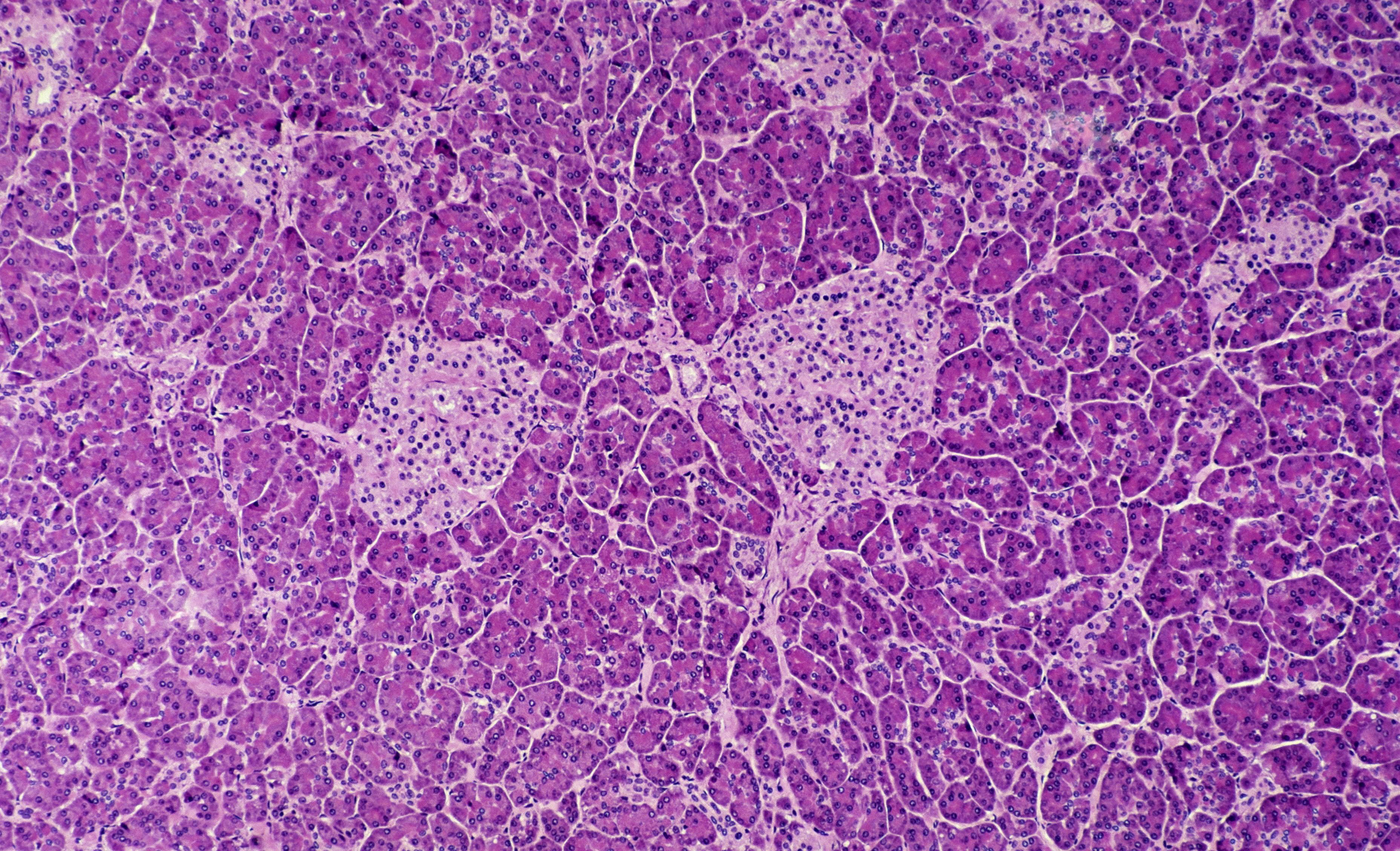
In type 1 diabetes, the immune system destroys beta cells located found in the islets of Langerhans in the pancreas (shown here). (Image credit: Ed Reschke/Getty Images)
"The ATG worked wonderfully," she said. The beneficial effect "was the biggest in the smallest children."
This was the third study to confirm the effectiveness of ATG to delay beta cell loss, Mathieu added.
Notably, when researchers reviewed the data, they found a similar level of side effects in the intermediate- and high-dose groups, so they dropped the intermediate dose from further study. The biggest difference between the remaining high- and low-dose groups was the incidence of side effects. One of the most common ATG side effects is serum sickness, an immune reaction to foreign proteins that can be triggered by drugs made in the cells of other animals. (ATG is produced in the cells of rabbits and horses.) In the new study, serum sickness impacted 82% of the participants in the high-dose group and just 32% in the low-dose group.
What to read next
</aside><p>Meanwhile, in the low-dose group, 24% had cytokine release syndrome, a runaway inflammatory response that can include fever, nausea, fatigue, headache, and muscle and joint pain. About 33% of the participants who received the higher dose developed the syndrome.</p><p>"I think the reason this is somewhat promising is that it's now one of a handful of drugs that show you can delay type 1 diabetes somewhat," Mathieu said. Another benefit of ATG, Mathieu said, is that it's inexpensive and widely available.</p><p>Other medications that have been found to delay diabetes are teplizumab-mzwv (brand name <a data-analytics-id="inline-link" href="https://www.tzield.com/" target="_blank" data-url="https://www.tzield.com/" referrerpolicy="no-referrer-when-downgrade" data-hl-processed="none" data-mrf-recirculation="inline-link"><u>Tzield</u></a><u>)</u> and baricitinib (<a data-analytics-id="inline-link" href="https://olumiant.lilly.com/?gclsrc=aw.ds&gad_source=1&gad_campaignid=20953489850&gbraid=0AAAAABc8bcTH0i6vwJGg57ZJCQGUWOUXp&gclid=CjwKCAiA8vXIBhAtEiwAf3B-g1T1NwavRffEZG3SAUprN7GsHnwhoEV1AtN9ljTDDnV9J_OUY6FsehoC4cIQAvD_BwE" target="_blank" data-url="https://olumiant.lilly.com/?gclsrc=aw.ds&gad_source=1&gad_campaignid=20953489850&gbraid=0AAAAABc8bcTH0i6vwJGg57ZJCQGUWOUXp&gclid=CjwKCAiA8vXIBhAtEiwAf3B-g1T1NwavRffEZG3SAUprN7GsHnwhoEV1AtN9ljTDDnV9J_OUY6FsehoC4cIQAvD_BwE" referrerpolicy="no-referrer-when-downgrade" data-hl-processed="none" data-mrf-recirculation="inline-link"><u>Olumiant</u></a>). Tzield is given as a 14-day infusion, but it's only approved for use in "stage 2" diabetes — at which point the body has been making antibodies to insulin and has some abnormal blood sugar responses, but most of its insulin-making cells are still working. Few people are diagnosed with diabetes in this early stage, which limits the drug's reach.</p><p>Meanwhile, baricitinib — a rheumatoid arthritis drug that hasn't yet been tested in children with diabetes — must be taken continuously to prevent disease progression.</p><a id="elk-40825346-428c-45c9-b31c-2b041a950141" class="paywall" aria-hidden="true"/><h2 id="good-news-for-young-children-3">Good news for young children</h2><p id="elk-d43d4ea8-1daf-4d03-bb0b-bef3d8e48b6e"><a data-analytics-id="inline-link" href="https://medicine.yale.edu/profile/jennifer-sherr/" target="_blank" data-url="https://medicine.yale.edu/profile/jennifer-sherr/" referrerpolicy="no-referrer-when-downgrade" data-hl-processed="none" data-mrf-recirculation="inline-link"><u>Dr. Jennifer Sherr</u></a>, an endocrinologist and professor of pediatrics at Yale School of Medicine, who was not involved in the study, said the results were encouraging, especially for families who would find it extremely challenging to take off from work for their child to receive two days of infusions. In the study, those in the low-dose group received an infusion on the first day and a placebo on the second day, but the placebo day wouldn't be necessary if the drug were given outside a clinical trial, she noted.</p><p>Sherr also liked that the study included 5- to 11-year-olds. "Those are the kids who lose their beta cells so fast" after diagnosis, Sherr told Live Science. "Their insulin needs go up incredibly."</p><p>Sherr hopes that this less-expensive medication could ultimately be approved for use in diabetes to help give "kids a smoother ride," she said.</p><p>As for whether ATG is better than other alternatives demonstrated to delay progression, "many people think it's going to take a multi-agent approach," she said. In other words, to really stop T1D in its tracks, people would likely need to get multiple drugs, Sherr said.</p><p>It's premature to say one treatment is better than another. "I think what gives us hope for the future is [that] there are lots of things we can consider," Sherr said.</p><p>And in a clinical trial set to begin late this year or early next year, researchers will test a next-generation version of ATG made in genetically modified cows in people newly diagnosed with type 1 diabetes.</p><p id="elk-6996c06a-3e59-4253-add8-bcbf4049a005">The new drug, made by SAB BIO and called SAB-142, is grown in a <a data-analytics-id="inline-link" href="https://go.redirectingat.com?id=92X1590019&xcust=livescience_us_1330268674086437281&xs=1&url=https%3A%2F%2Fwww.nature.com%2Farticles%2Fsrep24897&sref=https%3A%2F%2Fwww.livescience.com" target="_blank" data-url="https://www.nature.com/articles/srep24897" referrerpolicy="no-referrer-when-downgrade" rel="sponsored noopener" data-hl-processed="skimlinks" data-google-interstitial="false" data-placeholder-url="https://go.redirectingat.com?id=92X1590019&xcust=hawk-custom-tracking&xs=1&url=https%3A%2F%2Fwww.nature.com%2Farticles%2Fsrep24897&sref=https%3A%2F%2Fwww.livescience.com" data-mrf-recirculation="inline-link"><u>cow that has been gene edited to produce human antibodies</u></a>, said lead researcher <a data-analytics-id="inline-link" href="https://ufhealth.org/doctors/michael-j-haller" target="_blank" data-url="https://ufhealth.org/doctors/michael-j-haller" referrerpolicy="no-referrer-when-downgrade" data-hl-processed="none" data-mrf-recirculation="inline-link"><u>Dr. Michael Haller</u></a>, chief of pediatric endocrinology at the University of Florida's Diabetes Institute and advisory board member for SAB BIO. . "The cow can then donate blood," from which the human antibodies are harvested, Haller told Live Science in an email.</p><p>The hope is that, because the antibodies are made using human genes, they will no longer trigger serum sickness in patients. The human antibodies are also less likely to cause the immune system to produce antibodies that block the drug's action, so in theory, Haller said, "the new drug may be safer and even more effective in type 1 diabetes."</p><p><em>Editor's note: Haller holds stock options in SAB BIO, in addition to being an advisory board member.</em></p><div class="mb-6" id="elk-a019fd41-286b-47ae-b3f4-800168f70283">This article is for informational purposes only and is not meant to offer medical advice.
","contextual_directives":{"intro_style_to_use":"humorous_exaggeration","heading_style_to_use":"witty","fallback_if_content_minimal":"Jika
An inexpensive drug that's been used for decades in transplant surgeries can delay the progression of type 1 diabetes in those newly diagnosed, new research suggests.In previous studies, a high dose of the immune-suppressing drug polyclonal antithymocyte globulin (ATG) reduced the loss of insulin-making cells in the pancreas, called beta cells. The new study shows that a much smaller dose is almost as effective at slowing disease progression in type 1 — but with fewer side effects.In type 1 diabetes (T1D), the immune system destroys the body's beta cells, which produce insulin, the hormone that allows glucose from the blood to enter cells, where it is used as fuel. Without enough insulin, glucose piles up in the bloodstream. You may like
</aside><p id="elk-aced8c7a-88d5-432c-a5d2-53cb2a825977">But there's a window of time soon after diagnosis, called the "honeymoon phase," in which beta cells still produce some insulin; this provides an opportunity to keep those remaining beta cells alive longer. A longer honeymoon phase and more residual <a data-analytics-id="inline-link" href="https://diabetesjournals.org/care/article/36/11/3454/37998/Residual-Cell-Function-3-6-Years-After-Onset-of" target="_blank" data-url="https://diabetesjournals.org/care/article/36/11/3454/37998/Residual-Cell-Function-3-6-Years-After-Onset-of" referrerpolicy="no-referrer-when-downgrade" data-hl-processed="none" data-mrf-recirculation="inline-link"><u>beta cell function</u></a> are tied to <a data-analytics-id="inline-link" href="https://www.livescience.com/health/medicine-drugs/new-drug-could-prevent-diabetes-complications-not-fixed-with-blood-sugar-control-study-hints" data-url="https://www.livescience.com/health/medicine-drugs/new-drug-could-prevent-diabetes-complications-not-fixed-with-blood-sugar-control-study-hints" data-hl-processed="none" data-mrf-recirculation="inline-link" data-before-rewrite-localise="https://www.livescience.com/health/medicine-drugs/new-drug-could-prevent-diabetes-complications-not-fixed-with-blood-sugar-control-study-hints"><u>reduced risk of diabetes complications, such as heart and kidney disease,</u></a> down the line.</p><p>It's this honeymoon phase that the new study was targeting. The study included 117 participants, who were between the ages of 5 and 25 and had been diagnosed with type 1 diabetes within nine weeks of starting the trial. The participants received either a high, intermediate or low dose of ATG: the high dose was equivalent to 2.5 milligrams of ATG per kilogram of body weight; the intermediate dose was 1.5 mg/kg; and the low dose was 0.5 mg/kg of body weight.</p><p>The researchers found that the lowest dose preserved beta cell functioning for a year, according to the paper published Sept. 27 in the journal <a data-analytics-id="inline-link" href="https://www.thelancet.com/journals/lancet/article/PIIS0140-6736(25)01674-5/abstract" target="_blank" data-url="https://www.thelancet.com/journals/lancet/article/PIIS0140-6736(25)01674-5/abstract" referrerpolicy="no-referrer-when-downgrade" data-hl-processed="none" data-mrf-recirculation="inline-link"><u>The Lancet</u></a>.</p><p>The trial was designed to help researchers analyze the lowest effective dose in children as young as 5 years old, lead study author <a data-analytics-id="inline-link" href="https://efpia.eu/miscellaneous-items/people/chantal-mathieu/" target="_blank" data-url="https://efpia.eu/miscellaneous-items/people/chantal-mathieu/" referrerpolicy="no-referrer-when-downgrade" data-hl-processed="none" data-mrf-recirculation="inline-link"><u>Dr. Chantal Mathieu</u></a>, endocrinologist at the University Hospital Gasthuisberg Leuven in Belgium, told Live Science. That's because the drug's side effects — such as harmful immune reactions — can be especially hard on them, she said.</p><div id="slice-container-newsletterForm-articleInbodyContent-3GFNdJJgjaABAddnYbzB58" class="slice-container newsletter-inbodyContent-slice newsletterForm-articleInbodyContent-3GFNdJJgjaABAddnYbzB58 slice-container-newsletterForm"><div data-hydrate="true" class="newsletter-form__wrapper newsletter-form__wrapper--inbodyContent"><div class="newsletter-form__container"><section class="newsletter-form__top-bar"/><section class="newsletter-form__main-section"><p class="newsletter-form__strapline">Get the world’s most fascinating discoveries delivered straight to your inbox.</p></section></div></div></div><figure class="van-image-figure inline-layout" data-bordeaux-image-check="" id="elk-5f713a99-e436-414e-a3fb-dbb80add0d6c"><div class="image-full-width-wrapper"><div class="image-widthsetter" style="max-width:4791px;"><p class="vanilla-image-block" style="padding-top:60.76%;"> <picture data-new-v2-image="true">
In type 1 diabetes, the immune system destroys beta cells located found in the islets of Langerhans in the pancreas (shown here). (Image credit: Ed Reschke/Getty Images)
"The ATG worked wonderfully," she said. The beneficial effect "was the biggest in the smallest children."
This was the third study to confirm the effectiveness of ATG to delay beta cell loss, Mathieu added.
Notably, when researchers reviewed the data, they found a similar level of side effects in the intermediate- and high-dose groups, so they dropped the intermediate dose from further study. The biggest difference between the remaining high- and low-dose groups was the incidence of side effects. One of the most common ATG side effects is serum sickness, an immune reaction to foreign proteins that can be triggered by drugs made in the cells of other animals. (ATG is produced in the cells of rabbits and horses.) In the new study, serum sickness impacted 82% of the participants in the high-dose group and just 32% in the low-dose group.
What to read next
</aside><p>Meanwhile, in the low-dose group, 24% had cytokine release syndrome, a runaway inflammatory response that can include fever, nausea, fatigue, headache, and muscle and joint pain. About 33% of the participants who received the higher dose developed the syndrome.</p><p>"I think the reason this is somewhat promising is that it's now one of a handful of drugs that show you can delay type 1 diabetes somewhat," Mathieu said. Another benefit of ATG, Mathieu said, is that it's inexpensive and widely available.</p><p>Other medications that have been found to delay diabetes are teplizumab-mzwv (brand name <a data-analytics-id="inline-link" href="https://www.tzield.com/" target="_blank" data-url="https://www.tzield.com/" referrerpolicy="no-referrer-when-downgrade" data-hl-processed="none" data-mrf-recirculation="inline-link"><u>Tzield</u></a><u>)</u> and baricitinib (<a data-analytics-id="inline-link" href="https://olumiant.lilly.com/?gclsrc=aw.ds&gad_source=1&gad_campaignid=20953489850&gbraid=0AAAAABc8bcTH0i6vwJGg57ZJCQGUWOUXp&gclid=CjwKCAiA8vXIBhAtEiwAf3B-g1T1NwavRffEZG3SAUprN7GsHnwhoEV1AtN9ljTDDnV9J_OUY6FsehoC4cIQAvD_BwE" target="_blank" data-url="https://olumiant.lilly.com/?gclsrc=aw.ds&gad_source=1&gad_campaignid=20953489850&gbraid=0AAAAABc8bcTH0i6vwJGg57ZJCQGUWOUXp&gclid=CjwKCAiA8vXIBhAtEiwAf3B-g1T1NwavRffEZG3SAUprN7GsHnwhoEV1AtN9ljTDDnV9J_OUY6FsehoC4cIQAvD_BwE" referrerpolicy="no-referrer-when-downgrade" data-hl-processed="none" data-mrf-recirculation="inline-link"><u>Olumiant</u></a>). Tzield is given as a 14-day infusion, but it's only approved for use in "stage 2" diabetes — at which point the body has been making antibodies to insulin and has some abnormal blood sugar responses, but most of its insulin-making cells are still working. Few people are diagnosed with diabetes in this early stage, which limits the drug's reach.</p><p>Meanwhile, baricitinib — a rheumatoid arthritis drug that hasn't yet been tested in children with diabetes — must be taken continuously to prevent disease progression.</p><a id="elk-40825346-428c-45c9-b31c-2b041a950141" class="paywall" aria-hidden="true"/><h2 id="good-news-for-young-children-3">Good news for young children</h2><p id="elk-d43d4ea8-1daf-4d03-bb0b-bef3d8e48b6e"><a data-analytics-id="inline-link" href="https://medicine.yale.edu/profile/jennifer-sherr/" target="_blank" data-url="https://medicine.yale.edu/profile/jennifer-sherr/" referrerpolicy="no-referrer-when-downgrade" data-hl-processed="none" data-mrf-recirculation="inline-link"><u>Dr. Jennifer Sherr</u></a>, an endocrinologist and professor of pediatrics at Yale School of Medicine, who was not involved in the study, said the results were encouraging, especially for families who would find it extremely challenging to take off from work for their child to receive two days of infusions. In the study, those in the low-dose group received an infusion on the first day and a placebo on the second day, but the placebo day wouldn't be necessary if the drug were given outside a clinical trial, she noted.</p><p>Sherr also liked that the study included 5- to 11-year-olds. "Those are the kids who lose their beta cells so fast" after diagnosis, Sherr told Live Science. "Their insulin needs go up incredibly."</p><p>Sherr hopes that this less-expensive medication could ultimately be approved for use in diabetes to help give "kids a smoother ride," she said.</p><p>As for whether ATG is better than other alternatives demonstrated to delay progression, "many people think it's going to take a multi-agent approach," she said. In other words, to really stop T1D in its tracks, people would likely need to get multiple drugs, Sherr said.</p><p>It's premature to say one treatment is better than another. "I think what gives us hope for the future is [that] there are lots of things we can consider," Sherr said.</p><p>And in a clinical trial set to begin late this year or early next year, researchers will test a next-generation version of ATG made in genetically modified cows in people newly diagnosed with type 1 diabetes.</p><p id="elk-6996c06a-3e59-4253-add8-bcbf4049a005">The new drug, made by SAB BIO and called SAB-142, is grown in a <a data-analytics-id="inline-link" href="https://go.redirectingat.com?id=92X1590019&xcust=livescience_us_1330268674086437281&xs=1&url=https%3A%2F%2Fwww.nature.com%2Farticles%2Fsrep24897&sref=https%3A%2F%2Fwww.livescience.com" target="_blank" data-url="https://www.nature.com/articles/srep24897" referrerpolicy="no-referrer-when-downgrade" rel="sponsored noopener" data-hl-processed="skimlinks" data-google-interstitial="false" data-placeholder-url="https://go.redirectingat.com?id=92X1590019&xcust=hawk-custom-tracking&xs=1&url=https%3A%2F%2Fwww.nature.com%2Farticles%2Fsrep24897&sref=https%3A%2F%2Fwww.livescience.com" data-mrf-recirculation="inline-link"><u>cow that has been gene edited to produce human antibodies</u></a>, said lead researcher <a data-analytics-id="inline-link" href="https://ufhealth.org/doctors/michael-j-haller" target="_blank" data-url="https://ufhealth.org/doctors/michael-j-haller" referrerpolicy="no-referrer-when-downgrade" data-hl-processed="none" data-mrf-recirculation="inline-link"><u>Dr. Michael Haller</u></a>, chief of pediatric endocrinology at the University of Florida's Diabetes Institute and advisory board member for SAB BIO. . "The cow can then donate blood," from which the human antibodies are harvested, Haller told Live Science in an email.</p><p>The hope is that, because the antibodies are made using human genes, they will no longer trigger serum sickness in patients. The human antibodies are also less likely to cause the immune system to produce antibodies that block the drug's action, so in theory, Haller said, "the new drug may be safer and even more effective in type 1 diabetes."</p><p><em>Editor's note: Haller holds stock options in SAB BIO, in addition to being an advisory board member.</em></p><div class="mb-6" id="elk-a019fd41-286b-47ae-b3f4-800168f70283">This article is for informational purposes only and is not meant to offer medical advice.
kosong atau terlalu pendek (<300 karakter), gunakan topik umumnya saja untuk membuat artikel yang tetap relevan dengan kategori [article_category], TANPA basa-basi pengantar."}},"generation_config":{"article_specifications":{"language":"Indonesian","target_audience":"Gen Z and Millennials","tone_and_voice":"Santai namun tetap proper dan berbobot. TO THE POINT, TANPA kalimat pemanis (fluff/filler) atau basa-basi bertele-tele. Voice harus seperti obrolan warung kopi yang cerdas: menghindari bahasa kaku akademis, tapi juga tidak menggunakan slang alay. Gunakan campuran bahasa baku dan kasual yang natural, disesuaikan dengan kultur audiens [article_category].","point_of_view":"Third-person neutral. DILARANG KERAS menggunakan kata ganti orang ('kamu', 'Anda', 'kita', 'kami', 'saya'). Objektif namun tidak netral - boleh ada keberpihakan halus untuk kritik konstruktif.","humor_style":"Satire dan ironi dengan pendekatan olok-olok yang cerdas. Gunakan metafora dan referensi yang sangat kental dengan [article_category]. Humor harus jadi entry point untuk diskusi serius, bukan sekadar hiburan kosong.","target_word_count":1200},"structural_rules":{"length_paragraphs":"WAJIB GENERATE EKSPANSIF: Minimal 12-15 paragraphs total. Kembangkan setiap poin analisis secara mendalam.","length_sentences_per_paragraph":"3-5 sentences yang padat informasi, hindari kalimat majemuk bertingkat yang berbelit-belit.","reading_time_goal":"5-7 minutes.","introduction":{"paragraph_count":1,"instruction":"WAJIB mulai langsung dengan paragraf pembuka
. DILARANG KERAS memulai output dengan judul atau . Buat pembukaan clickbait-style yang engaging dan LANGSUNG menohok ke inti masalah tanpa kalimat pengantar/pemanis. Hook pembaca dengan curiosity, exaggeration, atau analogi dari dunia [article_category].","style_options":["curiosity_driven: Pose pertanyaan atau fakta mengejutkan dengan twist humor.","humorous_exaggeration: Overstate masalah umum dengan gaya olok-olok yang cerdas.","category_analogy: Bandingkan situasi dengan elemen ikonik dari [article_category]."]},"body_setup":{"paragraph_count":"4-5 paragraphs","instruction":"Bangun background dan konteks dengan gaya observasional yang tajam. Jelaskan 'kenapa' dan 'bagaimana' kita sampai di sini. Jangan memutar-mutar kalimat; pastikan setiap kalimat memiliki substansi."},"body_core_analysis":{"paragraph_count":"6-8 paragraphs","instruction":"Presentasikan analisis utama secara lugas dan panjang lebar. Weave in humor, metafora relevan dari [article_category], dan varied sentence structures. Kritik harus tajam dan dikemas dengan olok-olok yang cerdas."},"closing":{"paragraph_count":1,"instruction":"Strong conclusive paragraph dengan insight thought-provoking. Natural ending dengan takeaway yang memorable. DILARANG menggunakan frasa kesimpulan klise seperti 'Kesimpulannya...', 'Pada akhirnya...', atau 'Oleh karena itu...'."}},"headings_and_seo":{"heading_count":"3-5 headings maksimal","heading_format":"HTML H2 ()","heading_instruction":"Tempatkan HANYA setiap 3-4 paragraf untuk memecah teks. JANGAN letakkan di baris pertama artikel dan JANGAN letakkan di setiap paragraf. Buat heading yang witty dan provocative.","heading_style_options":["descriptive: Clear namun dengan twist.","witty: Clever dan humorous.","domain_reference: Referensi spesifik ke kultur [article_category]."],"seo_rules":{"optimization":true,"keywords":["keyword_utama","keyword_pendukung_1"]}},"style_and_formatting_guide":{"bahasa_khas":{"vocabulary":["Gunakan campuran bahasa baku dan kasual millennial/gen z yang proper dan rapi.","WAJIB mempertahankan istilah teknis bahasa Inggris asli dari [article_category]. JANGAN TERJEMAHKAN SECARA HARFIAH.","Sesekali gunakan kata kasual seperti 'gimana', 'kalo', 'nggak', 'bikin', tapi jangan berlebihan."],"tone_markers":["Gunakan variasi kalimat - dari pendek punchy hingga longer explanatory.","Gunakan ... untuk emphasis halus atau istilah asing (italic).","Gunakan ... untuk key terms (bold)."]},"html":{"enabled":true,"paragraph":"WAJIB gunakan ...
untuk setiap paragraf.","bold":"WAJIB gunakan ... untuk emphasis pada key terms.","italic":"WAJIB gunakan ... untuk istilah asing atau emphasis halus.","headings":"Gunakan
...
HANYA untuk heading antar bagian besar (tiap 3-4 paragraf).","lists":"Gunakan / dengan untuk daftar jika diperlukan."},"punctuation":"Gunakan hanya tanda baca valid Bahasa Indonesia (.,;:!?) dan hanya karakter ASCII standar. Gantilah semua “ ” menjadi \" \" dan semua —/– menjadi -.","linking":{"internal_links_max":2,"anchor_text_style":"Gunakan anchor text natural dan relevan dengan konteks."}},"output_format_requirements":{"format":"STRICTLY HTML ONLY","structure":"WAJIB mulai output langsung dengan elemen . DILARANG ADA teks pembuka, meta-text, judul ulang, atau backticks markdown ().","headings":"Gunakan untuk memisahkan bagian besar. JANGAN gunakan .","wordpress_compatibility":"Output harus siap ditempel di editor WordPress (HTML) tanpa modifikasi.","no_metadata":"JANGAN include JSON, frontmatter, atau konten non-HTML di output akhir."},"negative_constraints":{"prohibited_content":["KATA GANTI ORANG: 'Anda', 'kamu', 'kita', 'kami', 'saya'. (WAJIB DIHINDARI 100%).","TERJEMAHAN HARFIAH ISTILAH TEKNIS: 'Semprotan' (untuk Spray), 'Partai' (untuk Party), 'Modus' (untuk Mode).","KALIMAT PEMANIS/FILLER: 'Di era digital ini', 'Tidak dapat dipungkiri bahwa', 'Seperti yang kita ketahui', 'Pertanyaannya, apakah...'.","META-OPENERS: 'Dalam artikel ini akan dibahas...', 'Mari kita ulas...', 'Berikut adalah...'.","Generic closing headings: 'Kesimpulan', 'Penutup', 'Akhir Kata'."],"prohibited_elements":["Memulai artikel dengan atau elemen judul apa pun","Meletakkan di setiap paragraf","Plain text tanpa tag HTML ","Emojis","Markdown formatting (*italic*, **bold**)","JSON atau code blocks di output"," headings"]},"signature_elements":{"kritik_konstruktif":"Selalu ada elemen kritik atau perspektif berbeda yang dibalut humor, to the point.","observasi_kehidupan":"Include observasi dari skenario [article_category] sebagai starting point.","smart_humor":"Humor harus cerdas dan layered, bukan sekadar joke surface-level."}}}


